 ELI BLAIR, MCC - Executive Business Coach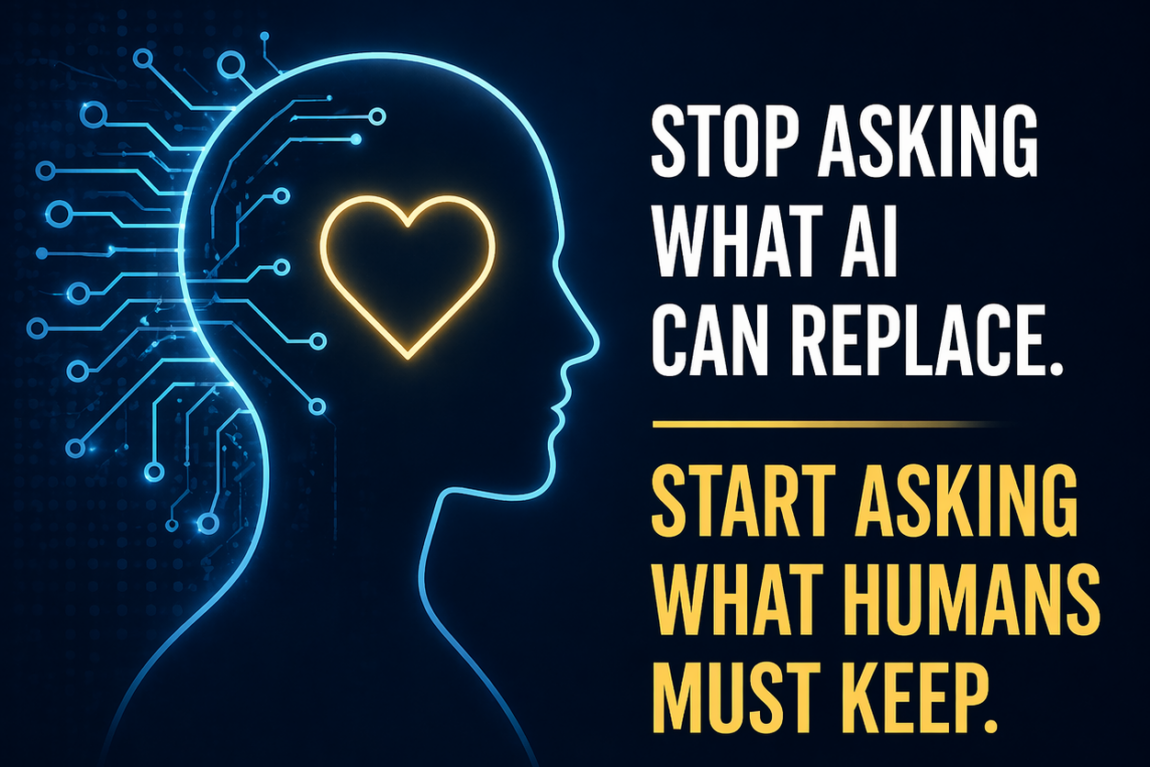
A lot of research is now focused on exactly that tension: AI as a labor-replacing technology versus AI as a human-amplifying system. The field is not usually framed as “conscious AI” in the academic or policy literature. The more common terms are human-centered AI, human-in-the-loop, human agency, augmentation, worker-centered AI, and socio-technical design. (arXiv)
Here is the honest picture from current research (April 2026):
1. There is real research showing meaningful job-displacement risk.
Recent work from Anthropic’s Economic Index finds that automation-oriented use is rising over time, and by September 2025 it had overtaken augmentation-oriented use in their data. Stanford-affiliated research also found early warning signs for younger workers in AI-exposed occupations, including a reported 6% decline in employment for workers ages 22–25 in the most AI-exposed roles from late 2022 to September 2025, while less-exposed jobs did not show the same pattern. Broader policy bodies like the IMF, OECD, and ILO also continue to warn that AI exposure is high in many knowledge-work occupations and that gains may be unevenly distributed across workers, wages, and regions. (Anthropic)
2. At the same time, a major research stream argues that replacement is not the only, or even the best, path.
NBER work in 2026 explicitly studies how to enhance worker productivity without automating tasks, arguing that AI can be designed as a tool that raises human output instead of removing humans from the workflow. MIT Sloan also highlighted research suggesting AI is often more likely to complement workers than replace them, depending on how work is redesigned and implemented. OECD work similarly stresses that AI’s productivity benefits depend heavily on whether innovations are built to augment capabilities of humans and machines together, rather than simply cut labor. (NBER)
3. One of the most important newer lines of research is worker-preference research: what do workers actually want automated?
A 2025 Stanford study built a large task-level dataset across 104 occupations and 844 tasks, using 1,500 workers plus AI experts. Its central idea is that the future of work should not be determined only by technical capability; it should also reflect the desired level of human involvement. The study introduces a Human Agency Scale and shows that workers often want automation for repetitive, draining, or low-value tasks, but want to retain human control in tasks involving judgment, accountability, care, trust, and social interaction. That is one of the clearest research efforts aimed at keeping humans meaningfully in the loop. (arXiv)
4. Another active area is work redesign rather than job deletion.
MIT’s AI Work Redesign Playbook is built around the premise that the impact of AI depends on design choices, and that frontline workers often have too little say in those choices. Related research in HCI and socio-technical design argues that organizations should redesign roles, workflows, escalation paths, and decision rights so AI removes drudgery while preserving human agency and meaningful work. In plain English: instead of asking, “Which jobs can we eliminate?” the research asks, “Which tasks should AI take, which should humans keep, and how should the handoff work?” (MIT Sloan)
5. There is also policy research on how to stop AI gains from becoming mass layoffs.
The OECD, ILO, and G7-linked work is increasingly focused on human-centered adoption, worker protections, skills transition, transparency, privacy, and social dialogue. A 2025 G7 compendium notes ILO estimates that in G7 countries, 6.5% of jobs, about 25 million jobs, are highly exposed to generative AI with many tasks at high automation potential. But the point of that work is not “accept the layoffs”; it is to push governments and employers toward transition planning, retraining, worker participation, and governance that supports better jobs rather than just cheaper labor. (OECD)
6. The research is increasingly moving from “job exposure” to “task exposure.” That matters.
Good researchers are getting more careful about not saying “AI will eliminate occupation X.” David Autor and others have argued that exposure alone misses the real story, because AI changes the mix of tasks inside jobs, not just the job title itself. That means the outcome depends on management choices: firms can use AI to cut entry-level roles and centralize expertise, or they can use it to raise the performance of more people and widen access to skilled work. (MIT Sloan)
7. On your phrase “conscious AI”: the serious work in this area is mostly not about making AI conscious.
There is some niche research touching artificial consciousness or “models that claim to be conscious,” and the OECD capability framework even discusses “conscious AI” as part of one capability taxonomy. But that is not the main body of research aimed at protecting jobs. The mainstream labor-and-governance work is about human-centered AI systems, not sentient AI. The practical question is not whether AI is conscious; it is whether systems are designed so humans retain agency, judgment, override power, and a fair share of the value created. (arXiv)
My read: the strongest research direction right now is not “build conscious AI so it cares about people.” It is build accountable, worker-centered AI systems and institutions so companies are not rewarded for replacing humans when augmentation would create more durable value. That includes:
- task-level human agency mapping
- worker participation in deployment decisions
- redesigning jobs around AI assistance, not removal
- mandatory human review in high-stakes decisions
- reskilling tied to actual workflow changes
- policy incentives that reward augmentation over pure labor substitution. (arXiv)